


Michele Losee with Finley, American Kestrel
Founder, Executive Director of IRFC
Photo: Jim Peterson
Love Raptors?
Me too!
That’s why we are both here…
This is why IRFC was founded
…so I get it.
Just like you, I love raptors and deeply want their world to be safe, whether in the wild or in captivity.
About Dr. Michele Losee
Dr. Michele Losee is a raptor ecologist, Master Falconer, researcher, educator and the Founder and Executive Director of the International Raptor & Falconry Center (IRFC), a nonprofit organization dedicated to advancing raptor conservation through education, science, falconry and environmental literacy.
With more than 24 years of experience working with birds of prey, Dr. Losee has built a career that uniquely combines academic research with practical field experience. She is among the relatively small number of professionals who have worked extensively as both a practicing Master Falconer and a research scientist, allowing her to bridge the gap between traditional falconry knowledge, modern ecology, animal welfare and public education.
Before entering the environmental sciences, Dr. Losee worked as a Nationally Registered Paramedic, including service as a flight medic on a neonatal and pediatric critical care transport team. That background in emergency medicine shaped the analytical thinking, attention to detail and decision-making that continue to influence her work with wildlife today.
She earned a Bachelor of Science in Biology from Texas Christian University, a Master of Science in Environmental Policy and Management, a second Master of Science in Interdisciplinary Environmental Studies, and a Ph.D. in Interdisciplinary Environmental Studies from Antioch University New England.
Her doctoral research examined the habitat characteristics, nesting ecology, and population dynamics of Arizona's Golden Eagles, producing one of the most comprehensive studies of the species in the state's desert ecosystems. Her work established important baseline information for conservation and land management while contributing to the broader scientific understanding of how Golden Eagles respond to changing landscapes, renewable energy development and other environmental pressures.
Throughout her career, Dr. Losee has remained committed to interdisciplinary conservation. Her work integrates ecology, falconry, behavior, captive management, environmental education and avian medicine into a single framework focused on improving outcomes for both wild and captive raptors. She has worked with educators, falconers, wildlife rehabilitators, researchers, students and the public to promote evidence-based approaches to raptor care and conservation.
In 2017, she founded the International Raptor & Falconry Center to address what she saw as a critical gap in public access to high-quality raptor education and professional training. Under her leadership, IRFC has become a growing center for science-based environmental education, live raptor experiences, falconry education, educator training and conservation outreach. The organization is guided by a simple philosophy:
Making the world a better place for raptors through education and science.
Today, Dr. Losee's work extends far beyond public programs. She is developing IRFC into a comprehensive clearinghouse for raptor knowledge; a place where scientific research, environmental education, falconry heritage, professional development and public engagement come together to improve both environmental literacy and the welfare of birds of prey.
Whether presenting to school children, mentoring future falconers, consulting with wildlife professionals, speaking to donors, or conducting research, her goal remains the same: to create a world where people better understand raptors, value their ecological importance and possess the knowledge needed to ensure their long-term conservation.

The emotional connections made with a live raptor is priceless and without it, it just makes conservation an uphill battle. - Michele Losee, PhD
Want the details?

Doctoral Degree Graduation with my good friend, Dr. Kimberly Craighead, Big Cat biologist and fellow nonprofit founder.
I am a Master Falconer with 24 years experience in raptor management and care and as an educator.
Before all that, I was a Paramedic in both a 911 EMS and neonatal/pediatric critical care team for the local Children’s Hospital’s critical transport. …which seems like a lifetime ago.
However! I didn’t always have this long list of ‘expertise’.
I was just a girl obsessed with raptors and veterinary medicine running on raw passion without a clue how to make a difference in their world. All I knew was I wanted to do my best for any bird that came into my life.
My first year as a falconer was nerve-racking! ...and still is at times.
I will never know it all, and I am learning constantly.
With no real plan, then over the next two decades, I read veterinary textbooks for fun, grabbed every single learning opportunity from the most respected people in the raptor world. I collected what little falconry books I could find. I found most books were too general and only covered the surface. This wasn’t enough for me.
People often ask me how I got into this; and this is the longest answer ever.
But it went something like this…
Starting a nonprofit wasn’t my childhood dream; I wanted to be a veterinarian since I was 5-years-old.
What derailed my path?
Marriage to an active duty US Marine. It is difficult to go to vet school when you move every 2-3 years so, I became a paramedic instead. It was medicine and it was intense; the two things I run towards.

This is what changed the trajectory of my life.
April 15, 1997
- Teddy Bear Air Cook Children’s Hospital
Fort Worth, TX
[Just for the record, I hate it when they say ‘ambulance driver’. There is a BIG difference between ‘driving an ambulance’ and being a NATIONALLY REGISTERED PARAMEDIC! ]
As a paramedic, I saved countless lives but my soul was screaming to do something greater.
Well, the universe intervened on the morning of April 15, 1997.
I was a part of a specialized critical care transport team for a children’s hospital and while rushing back to the hospital with an infant, a minivan slammed into the side of the ambulance. The driver was going so fast that it caused my 1-TON MICU to roll!
I remember hanging upside down from my seat belt and watching the glass of the passenger side window disintegrate as we slid across the intersection for what seemed like an eternity.
Afterward, while standing on the curb, wearing my blue flight suit, I looked at my supervisor at the time and said, “I’m done.” I never answered another ‘ring-down’. That week I applied for school to major in biology and never looked back.
At the time, I either wanted to go to law school for environmental law or PhD for research. I couldn’t decide so I thought I would apply to both and let the universe decide.
Well, it did. At the time I was to take my LSAT to get into law school, I had to have my gallbladder removed and missed the LSAT.
The PhD application went through and I was on my PhD journey.
🤔 Still deciding if that was a good thing or not.
I had always loved all animals, especially birds but knew I needed to specialize in a particular species. I went back and forth, overthinking it and then the universe stepped in again.
On May 29, 1997, I was at one of those clichéd renaissance faires with my family. We watched an education program disguised as a Falconry demonstration for King Henry VIII’s court.
Afterward, we went to where the birds were perched for the public; there was a Red-tailed Hawk that I just adored. I can still see her in my mind 25 years later.
I decided at that moment that I would devote the rest of my life to raptors. And I have done exactly that ever since…
So there you have it, the very same educational programs that I do now, is what inspired me to devote my life to the conservation of raptors.
2002 Graduated from Texas Christian University with a BS in Biology
2002 National Zoo doing educational talks in front of their Bald Eagle Exhibit and began doing raptor rehabilitation and education for a Northern Virginia organization
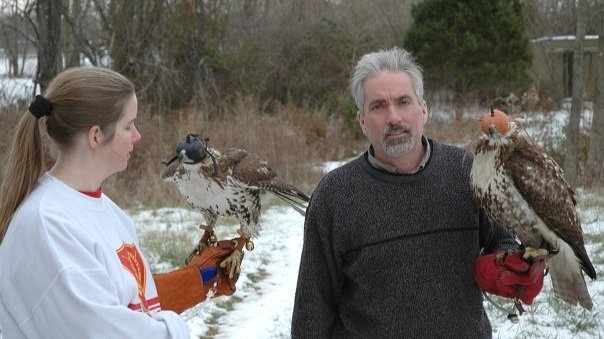
The day I trapped Guinevere, December 11, 2005.
with my sponsor, Liam and his new Red-tailed Hawk
2005 After years of postponing because of constant moving due to duty station changes or deployments, I became a falconer!!
My life has not been the same since.
My sponsor was Liam McGranaghan, a well-respected falconer from Northern Virginia.
My first hawk was a HUGE female Red-tailed Hawk that I named Guinevere.
October 2005 Spent time at The Raptor Center in Minnesota for various workshops and continuing education learning training, raptor husbandry/captive management, and avian medicine.

This was the first workshop they offered. I use what I learned still to this day. Priceless educational value and my birds have received the benefits.
2011 Started out as an exciting time. After nearly 25 years, my ‘then’ husband was retiring from the US Marine Corps. After I had sacrificed my own dreams for the sake of the mission, we were returning to my hometown of Sedona, AZ.
It was going to be MY TURN.
However, he decided that I was better off without him, and it turns out he was right.
My strategy to cope? Run away to England! Some join the circus, I went to the International Centre for Birds of Prey in Newent, Gloucestershire, UK.
I learned more there than all my years of falconry to date. ICBP is the oldest and the best bird of prey centers on the planet. ICBP is lucky to have the legendary Jemima Parry-Jones at the helm.
And she signed my divorce papers, my new life!
2012 Earned my MS in Environmental Policy and Management
2013 Back to Sedona, AZ from the UK and then Flagstaff, AZ.

Doing a school program UK - 2012
To my knowledge, I am one of the very few individuals that is a master falconer, researcher holding a Ph.D., rehabilitator, and educator. Although you can be one without the other, I set out to be an interdisciplinary expert that intertwines all expertise to provide me with unique insight.
2014 June - Coral arrives from the UK to AZ!!
She was my bird in UK and I brought her back to America with me. Because I knew no one else would put up with her charming personality.
2014 July - Moved to New Hampshire to wait for a job in VT and to work my PhD
2015 May - Moved to Woodstock, VT to run a falconry center for a Massachusetts falconer. Just a side note; I also learned why there are very few falconers in Vermont, because the falconry in Vermont is horrible! I did not see a single rabbit and squirrels were only seen in the middle of town.
2016 - Back to my hometown, Sedona, AZ but later moved to Flagstaff, AZ.
July- 2017 - Founded the International Raptor and Falconry Center!! I worked hard to gain our 501(c)3 in record time (less than 3 months), designed our logo, website up and running in a couple of weeks.
2018 - Teaching Global Environmental Issues at Coconino College
2018 – Earned MS #2! Interdisciplinary Environmental Studies
2019 – Earned Ph.D. Environmental Studies
Dissertation: Habitat characteristics and nesting ecology of Golden Eagles in Arizona

World Falconry Day with Quinn, the Ferruginous Hawk in Sedona.
Photo was part of an article in Red Rock News to celebrate World Falconry Day 2019 and falconers doing conservation.
Photo: David Jolkovski/Larson Newspapers
IRFC was a 10+-year-old aspiration of having a Center that represents a true clearinghouse of knowledge of ‘all things raptor’. A place of knowledge through research, a place of helping the injured and sick through rehabilitation and state of the art avian medicine and a place of learning through education.
My falconry culture is incredibly important to me. Due to the lack of access for those who want to learn about falconry, I really want IRFC to play a vital role in providing education and experiences in falconry. Additionally, I want IRFC to be a place of understanding even for those who might misunderstand falconry.
As a researcher, Dr. Losee, that’s me, believes research is essential to the conservation of raptors. Without the knowledge gained from research, there are no data for education. We cannot educate what we do not know and, thereby, conserve what we love.
Research is really considered a conversation, over time researchers add to the conversation with newly collected data and the conversation confirms the story is still valid, changes direction or tells a better story.
Adding to the conversation of science through research and education allows us to apply what we know; both are vital to making the world a better place for raptors.
There have been (still) moments I have wanted to give up. However, I believe in what this could mean for the raptors of Northern Arizona and even globally so, I dig in with more grit. The need for proper medical care for sick/injured raptors alone keeps me motivated.
My drive to make this vision a reality seems to be stronger than any setbacks; and there have been many.
My ultimate vision for the Center is to be a specialty center devoted to raptor species from all over the world for the public to visit and enjoy.
And a center for people to learn about falconry and a place for falconers to learn their new skills. Hence the name International = I did not want to pigeon hole the center into a specific locale or narrowed collection of species. Raptor = raptor conservation/education/husbandry. Falconry = learn about falconry and a place to learn for falconers. Center = a place to do all the above.
And that is where I will leave it.